Thread Weights Look Like What?

Lots of science boils down to this: 

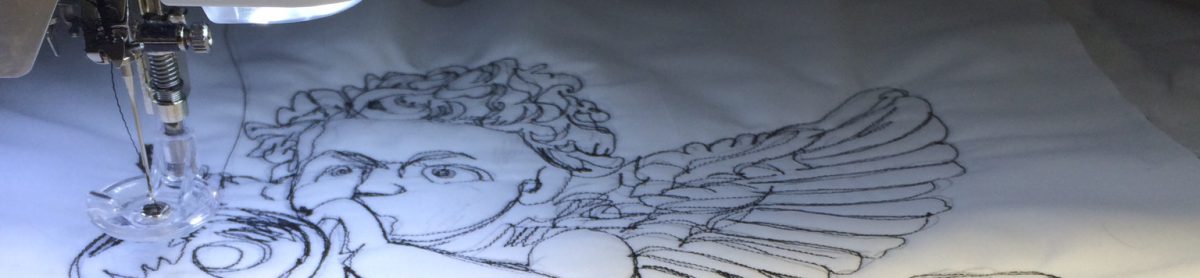
Higher wt number on thread means it is skinnier and will kind of hide so the fabric is more emphasized. The lumps and bumps are more emohasized. 

Lower wt thread is thicker thread so the thread shows more. 

Choose your thread weight by the effect you want to get out of your quilting.  

Of course, if you want to break the rule of thumb, then pile on and paint with the skinny thread to show up more like Libby Lehman does it. 

And think about this, if your freemotion or longarm pattern requires a lot of traveling over previous stitches, a thinner thread won’t pile up as much as a thick one. 

On Long Arm Quilting with Monofilament

For Superior Threads Monopoly in the top and Bottom Line (or any thread in the bobbin) in the bobbin. I use the TOWA tension gauge to set my bobbin case to a value of 180. I loosen my top tension knob about 2.5 turns.

This week on my facebook longarm quilt group, a member asked about using monofilament. I mentioned monofilament in a blog post https://wordpress.com/post/freeformquilts.com/626 a while back. Now that I have experimented more with monofilament I need to save my observations here.

I want a monofilament that sews like regular thread but “disappears” into the background fabric so that the quilting and fabric are emphasized instead of the thread lines. After many combinations and brands of monofilament, I finally came up with a repeatable easy solution that works every single time for me. I use Superior Threads Monopoly in the top and Superior Threads So Fine in my bobbin.

Thread Chemistry affects stitching

I tested several clear monofilament threads. Mono filament thread is a single continuous strand of fiber of polyester. Polyester seems to be stronger than other monofilament thread types.

Nylon monofilament threads stretched more and I didn’t like using them, even when I had all the tension loosened way up, they still stretched. I didn’t like how it formed stitches and I liked even less how much they could pull fabric up and warp it.

Quality of thread manufacturing also affects the stitch out. A single strand that is made to exacting thickness will give a consistent result. In a multi fiber thread, slight variations of thread thickness are compensated by the multiple fibers. In a mono filament, a thinner section of thread can cause breakage and malformed stitches.

Once I got my machine setup to form beautiful stitches Superior’s Monopoly did not break. Monopoly also comes in both a clear and a smoke color.  Monopoly is matte finishe and so you don’t see a “sparkle” when looking at the quilt from an angle. The smoke is also clear but smokey looking which is great on darker fabrics as light reflectance is minimal and this thread really disappears on dark backgrounds. Due to its matte finish and strength and consistent stitching, I greatly prefer Superior Threads Monopoly.

What is monofilament?

Keep in mind any mono (one strand) filament thread is going to be weaker than a two strand or three strand thread, to compensate that one strand is going to be a little thicker than the single strand of a multi-strand thread. It’s worth mentioning because you might observer that the thread is a little thinner than what you would normal consider for a specific needle size. In face Superior is only .1 mm thick! Needle choice will have a BIG impact on stitching with monofilament. Try first what the manufacturer of that thread suggests. It really does matter.

Needle Size

Superior recommends a #14 needle. I generally use a #14 needle but may go up to a #18 needle in certain cases. If it seems the needle flexing is causing the monopoly to break, go up to a bigger needle size. This is more of an issue when freemotion quilting with monopoly. A thicker/bigger needle is stronger and going to flex less.

Threading path changes

If I am having the monopoly break, I check my threading path. I thread through the only one hole in the top guide post instead of the normal winding around through both holes on the top guide.

Tension really matters

The key to beautiful stitches with Monopoly is your thread tension balance between the top and the bottom. You will need to loosen your top tension. On my Innova two to three full turns to loosen the top tension knob are required. Exactly how much depends on the thread I choose for the bobbin.

Bobbin Thread Affects Stitching with Monofilament

I have found that using monofilament in the top and bobbin really doesn’t work. Monofilament, because it is only one strand of fiber, is very slippery. The monofilament will not “grab” onto another monofilament thread and so the stitch doesn’t form and hold. Sometimes the stitches even skip completely. To get a good stitch formation, I have found that using a multi filament thread in the bobbin is a must. The multi-filament thread will grab the monofilament and form a better stitch.

I choose my bobbin thread based up on the effect I want to see on the back of the quilt. If I want the bobbin thread to have a disappearing effect, I will choose a bobbin thread such as #60 bottom line by Superior and very closely match the color to the quilt backing. Bonus to this combo is that Bottom Line is very thin and a LOT of yardage fits on a bobbin. Less bobbin changes is a very good thing in my mind. I often use #50 weight of many types such as cotton or trilobal polyester. I rarely go to a thicker thread, but have successfully used #40 weight polyester thread too.

Bobbin Case and Tension

The key to the bobbin thread no matter the thickness, is to have consistent tension.I keep repeating this because it is just that important.  I have a TOWA bobbin gauge and that has made all the difference in my long arm quilting. GET ONE!

Summary of What I Do to Set Up for Monopoly

For Superior Threads Monopoly in the top and Bottom Line (or any thread in the bobbin) in the bobbin. I use the TOWA tension gauge to set my bobbin case to a value of 180.  I loosen my top tension knob about 2.5 turns. Then I test on the edge of the quilt sandwich set and adjust only my top tension knob either looser or tighter to get a perfect stitch. I also test after each bobbin change or whenever I feel the stitch isn’t right.

Problem Solving Tips

  • Pokies on the top = loosen top tension and/or check bobbin tension with gauge
  • Pokies on the bottom = tighten top tension and/or check bobbin tension with gauge
  • Shredding thread.. quilt fabric and batting tension might be too tight. Bop it and see how it bounces. I have a habit of making this too taut.
  • Refer to my troubleshooting notes.


Bernina 830 versus Janome MC15000

My conclusion, each of these machines has pros and cons. I COULD live with either one. But I am lucky that I can afford both. So I generally piece quilts on my Janome, MC1500, while I appliqué and free motion on my Bernina 830. I will use either machine during embellishing art quilts depending on what stitches or effects I want. I embroider much more on my Janome because of the ease of monitoring and changing thread (nice threader).

I have been a member of the The Quilt Show for several years. Recently we started a thread about machines and features. I felt compelled to write about my two favorite machines. Here is what I posted to the forum on the Quilt Show.

Since a few have posted about their Bernina 830 experience. I thought I would too. I did not get a lemon and I absolutely love my 830. It is a solid workhorse for me. It takes any thread I throw at it even metallic. And I love the huge hoops. I also have a Janome MC15000 and I like it too. However it doesn’t free motion as well. It straight stitches better. However the Janome has a tendency to have nesting thread on the beginning of a stitching line. The Bernina does not.

Here is my experience Bernina 830 vs Janome MC15000

Straight stitching: Janome wins with a beautiful straighter stitch but with the caveat to use a bit of scrap material to start other wise I get a rats nest on the bobbin thread at the beginning of a stitching line. Holding the top and bobbin works too, BUT who wants to do that if they have an automatic thread cutter. You can attain a very nice straight stitch on the Bernina if you use a single hole plate, and carefully match your thread to needle size. But still Janome’s is a prettier straight stitch.

Thread cutter: both machines will cut thread. I think cutting is faster on the Bernina than on the Janome (this is an impression, not measured with a stop watch). Bernina sews without nesting after using it’s cutter. Janome will form nests if you sew after the cutter. On the Janome you will need to use a bit of scrap or pull out and hold the thread tails when you start sewing again.

Freemotion: Bernina wins hands down, no contest

Needle threader: Janome’s is better and more consistently threads the needle. Both machine’s needle threaders work better than my lower end machines.

Heavy or lots of layers : It really depends. Heavy tight weave several layers like quilting on a denim from denim backed with batting, I use my Bernina. Thick tough fabrics like cordura 400 or 600, I use the Bernina. The Bernina doesn’t skip stitches like the Janome can in situations like this. “This” is comparing same thread, same needle, same fabric, same number of layers, and sewing at half speed machine, etc. I do like the dual feed on the Bernina, especially when piecing flimsy or wispy light weight chiffon or silk fabrics. BUT! I like the ease of adjusting the pressure for the dual feed on the Janoma. I think the dual feed on the Janome is better for normal quilting cotton and cotton batting. I go to my Janoma for doing straight stitch quilting in a modern quilt kind of look where you would quilt with lots of straight lines or expanding circles or spirals. Bernina actually recommends an extra walking foot for this kind of quilting.

Embroidery: Both work great. Both do a great job. But due to thread change on these single color machines, I prefer the Janome because of it’s more consistently working needle threader. (though I Think the thread path on the Bernina is easier to do). MC15000 has an extra pro: I like the fact this machine is wi-fi capable.. that I have an app on my iPad that I can ‘see’ where in the process the embroidery is, if thread broke, if the machine stopped, and if i need to change colors. I can run around my home and do chores while doing embroidery without having to check to see the status of my machine. I actually get more embroidery done because of this.

Knee lift: have to put two paragraphs one for each machine explain this one.

Pro for the Bernina is that the knee life is mechanical. This makes doing appliqués more fun on the Bernina instead of the Janome. I can barely raise or take the pressure off the fabric when turning curves or corners and still have some pressure from the foot helping me keep things lined up and it acts like an extra hands. On the Janome, the knee lift seems to actually be an electronic switch, when I use the knee lift, there is no infinite range of lifting the pressure foot, it is either up or down. I don’t like this. So I typically do appliqué on my 830. (I also prefer the double blanket stitch the Bernina has over the similar stitch on the Janome).

Pro for the MC15000 is the knee lift will set to control other things besides lifting the presser foot, you can use it to control stitch width. Yes, really! So for an art quilter, I can use it for neat effects. I also use it when couching lumpy irregular yarns and other items to art quilt while embellishing. It’s very fun once you learn how to control it.

Conclusion

My conclusion, each of these machines has pros and cons. I COULD live with either one. But I am lucky that I can afford both. So I generally piece quilts on my Janome, MC1500, while I appliqué and free motion on my Bernina 830. I will use either machine during embellishing art quilts depending on what stitches or effects I want. I embroider much more on my Janome because of the ease of monitoring and changing thread (nice threader).

There Is A Philosophy of Monoprinting?

Glad I asked me that…

There is serendipity and a leap of faith in the act of monoprinting. Faith is something we all need more of.

Most printmaking is all about making hundreds or thousands of copies of something all the same. Mono printing isn’t like that at all. The genius of monoprinting is that it is a one shot deal. Every print you make will differ.

In mono printing, you spread paint on a surface and transfer it to another surface. You can manipulate the paint in-between if you wish. You can manipulate the surface you put the paint on and you can manipulate the surfaces you press onto the paint. But you can never identically reproduce the exact same chaotic placement of every bit of paint. You can make things similar, but never identical. So you can make coordinating prints that look really good together for triptychs or series of art objects.

All that similar but different concept attracts me to it. Kinda like how I am attracted to people. I love that people are different. If we all were the same and had all the same ideas, and all the same way of doing things, the world would be a really boring place. Monoprinting also appeals to the scientist in me. One of my favorite classes had a section on chaos theory and how organization comes from disorganization. Monoprinting is a bit like that.

You could put paint right on the fabric but it just won’t look the same as monoprinting. You would lose that bit of specialness that monoprinting imparts. There is a spontaneity that we should all have in life and monoprinting is a kind of physical evidence of how a little chaos results in something wonderful.

Monoprinting can also change a fabric, it can tone down one that is too wild or it can add energy and interest to a fabric that is dull or boring. Sometimes a little dab of paint will do it. Same with people, animals, and things. All our experiences rub off on us and change us a little bit. Every encounter we have changes us a bit, every encounter changes the fabric. The more I think about it… there is a philosophy we can learn from monoprinting.

Once I get out of my introspective mood, I’ll write up another post about my low budget monoprinting presentation soon.

I have demoted two of my free motion quilting tools.

Seriously, I found something last month, used it today and immediately bumped it to the top of my favorites list. The quilt halo. It is a hefty iron ring coating in a slightly tacky plastic. It really keeps the fabric from bunching up right under the needle. Keeps the fabric flat and at just the right tautness or flatness which helps with tension issues. I don’t have to wear those uncomfortable gloves any more. It makes me happy! Oh, it also seems to lessen the need for a free motion slider.. but with both in place.. it’s like quilting on an ice rink. Seriously, I like this tool. If I had to choose between the slider and the halo. I’d pick the halo. Before you ask, NO! I’m not getting paid to endorse. I just like this tool a lot. If you local quilt store doesn’t have it, you can buy it from the source.
http://purpledaisiesquilting.com/collections/top-10-products/products/quilt-halo-free-motion-quilting-tool

I Love this free motion quilting tool for holding fabric
Quilt Halo is amazing for free motion quilting. It holds the fabric flat and makes it super easy to move it around. It’s better than those uncomfortable gloves and way better.

Free Motion Troubleshooting Skipped Stitches

Frustration City! Skipped stitches can really make free motion not fun. And it really should be fun. I can’t recommend enough to always test your exact materials and design elements on a test sandwich first before you start on your quilt. Also, fresh needles can solve many problems

Skipped Stitches are caused by a lot of things. But usually the culprit is misthreading or a damaged or dull needle. You might have just put a new needle in the machine and that needle could still have a micro sized burr in a bad spot somewhere. Or maybe you are like me and think you can eke out the whole darn quilt including patchwork and quilting with one needle. Well, that needle is probably the problem. There is a reason that sewing machine makers make the needle so easy to replace.

The needle is easy to replace because we are supposed to do it pretty often.

  1. Are you sewing with your presser foot down? Often new free motion quilters will forget. If the presser foot isn’t down, then the tension discs can’t help form a stitch.
  2. Replace the Needle – needles are the cheapest part of your sewing expenses. Try just changing it out. You don’t have to use them, but I like titanium coated needles. I explain why in this post.
  3. Is your needle the correct size? You choose fabric and thread first, then match the needle to it. Here is more info on Thread Weights and Needle Sizes for Free Motion
  4. Take the thread out of your machine and clean your machine. Be sure to take the bobbin out for good measure too. Clean it, clean the bobbin area, if you can remove and clean the bobbin casing then do it. Take the presser foot plate off and clean under it. Clean lint off the needle holding metal bar thingy (very technical term there). Clean it all.
  5. Rethread the machine properly.
  6. Is your presser foot up before you thread? If you don’t bring up the presser foot, the thread can not get in-between the tension disks. This is a problem as stitches can’t form..
  7. Is your bobbin oriented the correct way (does it spin the right way once it is inserted in the machine)? If there aren’t arrows stamped in your machine, are you sure you’ve seen the manual to know. One friend actually sewed for years with the bobbin going the wrong way. It was okay for straight stitch, but when she finally wanted to learn free motion quilting, it didn’t work well at all and caused skipped stitches.
  8. You can look through my troubleshooting posts on this blog and hunt online for answer. These are collated from personal experience, other free-motion quilters, Superior Thread Company, Schmetz Needle Company, and a lot of other sources. This is all common knowledge stuff, no rocket science here or proprietary info. But I hope it helps you. I use my blog as a resource all the time. I love comments too. Please help if you know something else that should be added, or another solution.

I do have a chart in the works that I promise to post in the near future.

An Easier Way To Join Binding Ends

Oh Snarky Quilter! Thank you for posting the link to the McCall’s video. She explains it so concisely and well demonstrates it. Why recreate something that’s so well done.. unless you want to wear nail polish or something. But when I put that stuff on, it just looks clumpy and totally bad on my man hands. (I’m not a man, just have man hands)

snarkyquilter's avatarThe Snarky Quilter

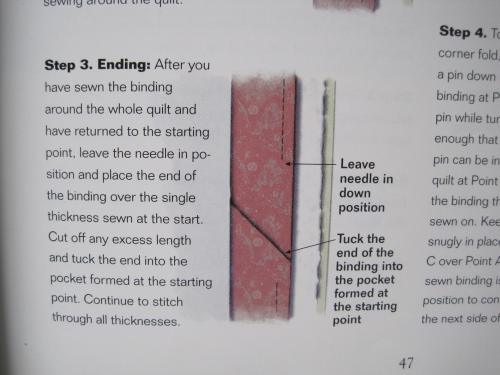
Try this ridiculously easy trick—just kidding—but I did find an easier way to get the ends of my quilt bindings sewn together. Back in the day, quilters were advised to tuck the tail into the binding start that had the edge turned under. This left you with an unsightly bulge.

binding_instructions

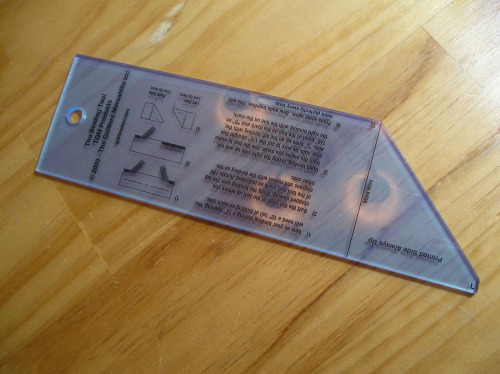
Then, other methods were put forth to join the two ends at a 45 degree angle. In fact, there’s even a gadget sold to help you do this.

binding-tool

I’ve been using my own version of Sharon Shaumber’s method, which works but is a bit awkward. Then, I found a new method on one of my Pinterest feeds. It advertised ease and success, so I saved it and tried it out for my recent binding marathon (3 quilts in 2 weeks.)

This method comes from McCall’s Quilting, of all places, and you can watch a video on how to use it.

View original post 120 more words

Yet Another Instruction Guide on Tube Cut Bias Binding

I was in a class last week and we were supposed to do tube cut bias binding. I find this the best way to make bias in the entire world. But I had a major brain fart! It was, to say the least, a bit embarrassing. At that moment, I couldn’t have even told you what make my car is. Luckily we planned for overflow time the following Tuesday evening.

I made some notes and turned the unfinished keynote address into a Quicktime video. I will probably come back and add a voice over at some point. But the keynote slide show is what I’ll be actually using as a classroom aid. It will play better live in person.

Here it is for those of you who want an early peek.

Free Motion References

Sites

Free Motion Quilting Project – This is probably the best site for learning free motion quilting that I can think of. Leah Day clearly explains what she is doing, how to do it yourself and she has Craftsy classes too. She has done tons of online examples. She recently started publishing her designs in books, so if you are a person who prefers to browse books for ideas, she is there for you too.

You also might want to follow along with Leah’s Building Blocks Quilt Along. You can find it on Facebook and her website that I linked to above.

Books

Free Motion Quilting by Kent Mick Book
You can get it on Amazon here Free Motion Quilting by Kent Mick Book
The book the store did not have in stock because they sold out. I highly recommend this for a beginner or never ever free motioned before person. It is a short book at only 32 pages. Don’t be fooled though. It gives you exactly what you need and nothing more. No silly same old filler pages like so many other quilting books have now days.

Free Motion Quilting On Your Home Sewing Machine by Kent Mick. You can get it on Amazon or at almost any large quilt shop. It should be $12.95 or under.

Books I passed around class:

Link to Amazon Free Motion Quilting From Feathers to Flames by Leah Day
Free Motion Quilting From Feathers to Flames by Leah Day
Free Motion Quilting From Feathers to Flames by Leah Day is available on kindle and as a regular book.. She has a DVD and other books available too. I call this Leah’s red book. It is a great portable spiral bound smaller sized book full of examples. Wonderful textures of feather and flame designs. I use this for inspiration often. She includes over 50 designs and instructions. She also shows how to transform a simple design into something more complicated looking by just changing it up a bit. I love this book.

Buy Diane's book on Amazon here.
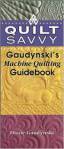
Quilt Savvy: Gaudynski’s Machine Quilting Guidebook by Diane Gaudynsky
Quilt Savvy: Gaudynski’s Machine Quilting Guidebook by Diane Gaudynski has great examples photos. It is in a vertical format so easy to carry around to retreats or keep by your machine. This book as great trouble shooting tips. Want to know why you have little wads of thread at your points? She tells you. I think this book is very wordy if you think it’s just a reference guide. It isn’t. She gives lots of advice on many aspects to machine quilting (aka free motion).

Titanium needles are not too expensive

Titanium coated needles are sharper, lasts longer and end up being cheaper in terms of how many needles I need to use to quilt the same number of miles of thread.

As a quilter, 90% of my free motion to date has been on cotton fabric, I delve into silks on occasion. I like top stitch needles for most of my sewing. Top stitch needles have a longer eye and deeper groove which protects the thread from rubbing and wear as it passes through the fabric and into the bobbin mechanism. I also spend just a little more on the titanium needles. I’ve been told by some of my friends that I’m crazy for doing so. I don’t think I am at all. Here’s why.

Being called titanium needles is really a misnomer. They actually are titanium-coated needles. The titanium doesn’t make the needle stronger in terms of not breaking, But it does make it wear longer against rubbing. And thread is abrasive, so is fabric. A regular needle lasts maybe 8 hours of sewing and needs to be swapped out. Thread will wear in the eye of the needle and fabric will wear the tip of the needle.

I’ve found a titanium coated needle stays sharper and lasts 2-3 times longer. It’s true that the titanium needles are more expensive if you compare needle to needle. But you can’t. Due to the life of the needle a titanium needle will last 3x the life of the regular needle. And they do not cost 3x the price. So I believe titanium needles are actually cheaper in terms of how many needles I need to use to quilt the same number of miles of thread.

And for metallic threads.. which I like to use a lot when free motion quilting… titanium is the way to go. Metallic and Top Stitch needles are identical. Same eye size, same groove, same tip shape.. So I use my better wearing titanium top stitch needle for metallic thread. Often shredding of metallic thread is caused by incorrect needle size or by a worn eye on the needle. A titanium needle lets me sew longer. I use a 90/14 for most metallic threads I own.

Do I use regular needles? Yes, I do. I can’t alway find titanium needles and I am going to sew anyway.