Free Motion References

Sites

Free Motion Quilting Project – This is probably the best site for learning free motion quilting that I can think of. Leah Day clearly explains what she is doing, how to do it yourself and she has Craftsy classes too. She has done tons of online examples. She recently started publishing her designs in books, so if you are a person who prefers to browse books for ideas, she is there for you too.

You also might want to follow along with Leah’s Building Blocks Quilt Along. You can find it on Facebook and her website that I linked to above.

Books

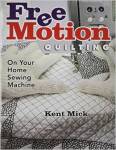
Free Motion Quilting by Kent Mick Book
You can get it on Amazon here Free Motion Quilting by Kent Mick Book
The book the store did not have in stock because they sold out. I highly recommend this for a beginner or never ever free motioned before person. It is a short book at only 32 pages. Don’t be fooled though. It gives you exactly what you need and nothing more. No silly same old filler pages like so many other quilting books have now days.

Free Motion Quilting On Your Home Sewing Machine by Kent Mick. You can get it on Amazon or at almost any large quilt shop. It should be $12.95 or under.

Books I passed around class:

Link to Amazon Free Motion Quilting From Feathers to Flames by Leah Day
Free Motion Quilting From Feathers to Flames by Leah Day
Free Motion Quilting From Feathers to Flames by Leah Day is available on kindle and as a regular book.. She has a DVD and other books available too. I call this Leah’s red book. It is a great portable spiral bound smaller sized book full of examples. Wonderful textures of feather and flame designs. I use this for inspiration often. She includes over 50 designs and instructions. She also shows how to transform a simple design into something more complicated looking by just changing it up a bit. I love this book.

Buy Diane's book on Amazon here.
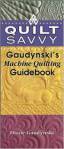
Quilt Savvy: Gaudynski’s Machine Quilting Guidebook by Diane Gaudynsky
Quilt Savvy: Gaudynski’s Machine Quilting Guidebook by Diane Gaudynski has great examples photos. It is in a vertical format so easy to carry around to retreats or keep by your machine. This book as great trouble shooting tips. Want to know why you have little wads of thread at your points? She tells you. I think this book is very wordy if you think it’s just a reference guide. It isn’t. She gives lots of advice on many aspects to machine quilting (aka free motion).

Most Unlikely of all Sewing Aids is Sex Lube

I like a challenge. One of my friends told me that I spend too much money on “Sewing Stuff”. So I set out to find alternatives to things I can buy in a quilt shop. This is the first in a series I plan to write about those alternatives. I decided to start with something that would make her eyes pop.

I like to free motion quilt with metallic thread. My machine handles it really well if I use the correct needle, turn the tension down a bit, and lubricate the thread.

Bernina’s Thread Lubricator Guide is fantastic. The guide comes with a tiny vial of silicone lubricant. You put a single drop of silicone lube on the felt pad, stick your thread in the groove and thread your machine like normal. The wee itty bitty bit of lube really makes a huge difference. However… the Bernina and thus its included guide fall into the spending money category. I had to find an el cheapo alternative for ‘any’ machine. Someone suggested mineral oil.. but hey that stuff smells, I’m not sure I want that around my fabric.

Before I got the fancy schmancy thread guide for my Bernina, I would buy Sewer’s Aid thread lubricant and put a thin stripe on my spool of metallic thread. This stuff is between 6-9 bucks for a little half ounce bottle. And, it’s made of liquid silicone. I also know for a fact that the Bernina lube is silicone. So here is where does the “sex” comes in.

Well… I couldn’t find that little bottle of Sewer’s Aid and it was 8 bucks so I really didn’t want to buy more of it being that I was on the “Cheap Challenge”. What did I have around that was silicone and liquid and cheap?

Image of a sample size of ID Millennium Lube
This sample size hold .1 ounces of lube. Perfectly safe for no leak carrying and ready when you are (for lubricating your thread that is).
A funny elf put a cute little sample size of ID Millennium lube in my Christmas stocking. Millennium supposed is incredibly good for doing the deed in a hot tub because it is liquid silicone and doesn’t dilute or wash off in the water. I was really hoping I was getting a hot tub for Christmas. But, alas, that was not to be. Hoping to have a hot tub tryst at some point in the future, I kept that little packet in a drawer. Knowing it was liquid silicone, now was the time to pull it out. Honestly if I’m not going hot tubbing with the hubby, a little late night experimental quilt action fulfills some of my needs pretty well.

A teensy dab of ID Millennium lube on my spool of thread and wa-la! It works!

I also found out a couple of drops of ID Millennium silicone lube is a great substitute for a Supreme Slider. Two drops of sex lube on a piece of batting, rub it around on my sewing surface and wow… It lasted a long time too. It isn’t icky, slimy, smelly, or any of those things. I priced a 12 ml tube (just under half ounce) and it’s about two bucks. At the one or two drop at a time rate I’ll use it, it will last practically forever.

Now about that tryst… I’m still holding out for a hot tub.

Titanium needles are not too expensive

Titanium coated needles are sharper, lasts longer and end up being cheaper in terms of how many needles I need to use to quilt the same number of miles of thread.

As a quilter, 90% of my free motion to date has been on cotton fabric, I delve into silks on occasion. I like top stitch needles for most of my sewing. Top stitch needles have a longer eye and deeper groove which protects the thread from rubbing and wear as it passes through the fabric and into the bobbin mechanism. I also spend just a little more on the titanium needles. I’ve been told by some of my friends that I’m crazy for doing so. I don’t think I am at all. Here’s why.

Being called titanium needles is really a misnomer. They actually are titanium-coated needles. The titanium doesn’t make the needle stronger in terms of not breaking, But it does make it wear longer against rubbing. And thread is abrasive, so is fabric. A regular needle lasts maybe 8 hours of sewing and needs to be swapped out. Thread will wear in the eye of the needle and fabric will wear the tip of the needle.

I’ve found a titanium coated needle stays sharper and lasts 2-3 times longer. It’s true that the titanium needles are more expensive if you compare needle to needle. But you can’t. Due to the life of the needle a titanium needle will last 3x the life of the regular needle. And they do not cost 3x the price. So I believe titanium needles are actually cheaper in terms of how many needles I need to use to quilt the same number of miles of thread.

And for metallic threads.. which I like to use a lot when free motion quilting… titanium is the way to go. Metallic and Top Stitch needles are identical. Same eye size, same groove, same tip shape.. So I use my better wearing titanium top stitch needle for metallic thread. Often shredding of metallic thread is caused by incorrect needle size or by a worn eye on the needle. A titanium needle lets me sew longer. I use a 90/14 for most metallic threads I own.

Do I use regular needles? Yes, I do. I can’t alway find titanium needles and I am going to sew anyway.

Thread Weights and Needle Sizes for Free Motion

You may hear a lot of things about what is the best or the only weight thread to use for free motion or longarm quilting. Personally I don’t think there are any rules. As long as you choose your thread, evaluate your fabric and then choose the appropriate needle for thread-fabric combo AND are willing to tweak your tension settings, you can free motion with almost any thread. Your machine just has to accept it. Some machines can be finicky about weights of threads or even material the thread is made of. Often you can tweak or adjust your method to help use it.

Quick Guide to Thread/Needle Size
Thread Wt Needle
40 wt 90/14
50 wt 80/12
60 wt 70/10
100 wt 70/10
12-30wt 100/16
MonoPoly

(Invisible monofilament)

70/10

Normally I go to a 50 weight cotton or polyester trilobal thread. I really like threads by Superior Threads, though I am not married to their products. Using a 80/12 Topstitch needle works great with their King Tut, Manifico and Fantastico lines. I have found that as long as I use the same thread in top and bobbin of my machine, I do not have to adjust tension at all.

Note: Superior Threads note on their spools and cones which tell you which size needle is recommended for that particular thread.

If I want a thicker line of thread to show, I will use a 40 weight thread. There are free motion people out there who do not like this thread. But I believe that if the look you want requires a 40 weight go ahead and use it. A 90/14 needle works great.

Thick threads have smaller weight numbers, while bigger needles have bigger numbers. Thread and needle sizes run in opposite directions.

You can even free motion with a 30 weight thread if you want, however, put it in your bobbin of your machine. Thick threads do not work in the top of a domestic sewing machine and will shred or mess up your top tension discs. So in the bobbin it must go. This is often called “bobbin work”. The process is the same, you will just have to work from the back side of your quilt so the heavy thread in the bobbin shows up on the front. If you think your machine could handle a 30 weight thread,  you would probably use a 100/16 needle.

Thinner threads than 50 can look really neat. Using silk 100 weight thread for example can have a really nice look. Some of the top free motion people who win shows use silk almost exclusively. I would try a 70/10 needle for this.

Monofilament is also an interesting choice. Typically it is almost colorless. It will really “disappear” into the quilt so the texture is really evident and the thread is almost unnoticeable. There are two types, nylon and polyester. In years past, monofilament, which was made from nylon, got a bad rap because in the early days when it was invented it was very stretchy. So it was difficult to use. You would have to go very slow and have very low tension settings. Nylon also melts at lower temperatures than other fibers. Lower temperatures mean more stringent rules for care of the quilt, you can’t iron it, must wash on low, etc. Newer polyester fiber is in several brands of monofilament. My experience has been with Superior’s Monopoly. It requires a couple more ‘numbers’ lower on the top tension and I do tend to go slower with it. But it really has a nice look, washes on medium heat, and can be ironed. It’s great for trapunto too. Monopoly is slightly matte and that helps it disappear too. It comes in a light/clear and smokey clear for using on darker fabrics. I don’t hesitate to use the light monopoly on dark fabrics if I do not have the smoke available. It really is fun to use.
Francis Ford Coppola Claret

Just popped a cork on some Francis Ford Coppola Claret, the black label bottle with the gold wire wrapping. YUM! I love this stuff. When I’m looking for a smooth robust red just for sipping. Or to pair with some tenderloin with some of my homemade passilla chipotle steak rub. I’m getting yearnings for meat and wine right now just thinking about it.

Complementary Improv Quilt named Earth, Wind, and Fire

My goal was to do a complementary colored quilt as an exercise in my exploration of the CMYK color wheel. I also challenged myself to pick the ugliest fabric I owned as a starting point.

I chose a ombre brown that looked like mud. I bought this on sale a couple of years ago and it never inspired me. I realized that I had a matching ombre blue that worked for a complementary color scheme. Initially I made about 30 blocks that were improvisational created by stacking two squares to five and cutting a curve through all them. I didn’t worry if the fabric shifted, I just used a rotary cutter to slice through all of it. Then I randomly shuffled the pieces and sewed them back together. It did not take long to realize how sleepy this soft brown and blue color scheme made me. It really needed something more. I pulled out Joen Wolfrom‘s color poster and realized that I had an orange that was actually the same color as the brown, just a different value. Wolfram is really changing how I think about color. It’s all about value. Thinking in value really simplifies things.

Bright orange is a very powerful color and in the case of this muted soft blue and brown scheme, it became very powerful indeed. Small doses were in order. I stacked up a few of the blue/brown blocks that had larger areas of contiguous fabric section and layered in an orange square and did my same improvisational curve cutting and piecing. I also sorted through my blocks and found several that were not large enough to allow me to easily square up all the blocks to maximize the sizes I could make. So I tacked some orange onto the edges of these smaller blocks to grow them. I am actually really pleased with these blocks. The fabric that I did not like, now looks like suede and the bits of orange really shape the path the eye travels over the quilt top. It reminds me of a kayaking trip with water, mud and flames.

I really need to put up a large design wall to layout all these blocks. It will have to wait for a retreat or something. I also have not decided if I will sash them like in the three row image or if I will just sew them edge to edge. I’m sure it will come to me at some point.

logo

Whine on the Porch

Whine on the porch is about… wine on the porch! Big old south Texas homes generally have a porch of some kind. You can tell a lot about the people who built that home. Homes built by people who are friendly and like to have friends over have bigger deeper friendlier porches. This blog is about what we talk about on the porch with friends over a glass or two of fine wine. Something magical happens on a porch with fine company and wine in hand.

Wine on the porch is about whine on the porch and about solving our town’s and our country’s problems. It’s about open discussion and freedom of speech and fine wine. Sometimes we even eat cheese or make wine! But most of all we talk.

[Republished from my original blog Whine on the Porch]

Beginning Free Motion Class Supplies List November 25, 2014

cropped-cropped-20131208-181349.jpg
For those of you who are taking my class. Here is a link to the pdf which contains the list of supplies and pre-work that you will need to do in order to be ready for the class.

If you have several feet that might work (see pdf) and don’t know which one is best, bring them all. we can talk about them in class.

Download Supply List by Clicking Here

Creatives Worldwide Blog Hop

As you all know, I’m a fan of Rose Hughes and her fast piece applique method. I have all her books and I can’t recommend them enough for anyone wanting to get into art quilting. She is now participating in a blog hop with this . I decided to follow along too.

Four questions to answer and I think it might clarify some things in my mind.

#1 What am I working on?
I’m working on four projects concurrently. The first is my giant rainbow elephant applique that is currently on my long arm. The second is a first time attempt at a drunkards path. I’m a member of the San Antonio Modern Quilt Guild and so I’m using a ‘modern’ ashy grey solid and mixing it with my beloved batik. All shades of blue in this case. I have no idea how it’s going to come out. Currently the blocks are all over my dining room table while I get inspired as I move them around. Hubby calls this “working on your puzzle”. The third thing I”m working on is a “fast piece appliqued” sea-horse art quilt. My friend Carol wanted to learn how to do it and so we each picked out a scene to do. We’ve got the piecing done but not the couching and quilting. I can never be working on just one thing at a time. I love having something arty that needs embellishing around that is portable so I can work on it in the car or on a plane. The fourth thing on my quilty agenda is outlining and making samples for my free motion quilting class that I’m teaching in November. I decided having some sample of thread tension and speed related issues would be nice to show. I think it’s like doing a foot book or a stitch out of all the stitches one’s machine can do. I’m learning a lot. The process of teaching and prepping to teach is very educational to me. It’s making me grow and be a better quilter myself.

#2 How does my work differ from others in the genre?
I supposed I don’t have a style yet. I’m still learning, trying other’s methods and muxing them together to invent easier ways of doing them. So I don’t know that it differs, other than I really mix it up a lot and you’ll find lots of different techniques on my work. Right now, you probably won’t see anything done the same way twice either. I don’t really like rules. So I suppose free form and rule free is more the way I do things. Though my drunkards path quilt now has a lot of straight lines between the blocks. hmm… guess I’m breaking my personal ‘rules’ too.

#3 Why do I create what I do?
Inspiration comes from everywhere. But most of all, I get inspired when I’m told I can’t do things “that way” or “that’s not going to work” or “no one does it that way” or “that’s not art.” Hearing statements like that just fire me up and make me want to prove that it can and is and is possible.

#4 How does my creative process work?
With my career in coding and web design work, I have always had the philosophy “work hard now, so I can be lazy later.” That translates to thinking about things a lot before starting work. I would rather get it right the first time and have a plan for dealing with the problems than get blind sided by issues later and have to apply a lot of bandaids to the code. Do it right the first time, so it wouldn’t have to be redone a second time. Take the time to do it right. That said, my philosophy, while great for programming, can get in the way of art. What ends up happening is that I tend to ponder on something for way too long before I go for it. But I am not fixed once set on a path. I also tend to switch strides in the middle of a plan and morph it into something else, something better.

Fall is Here and a Pumpkin Class

2014PumpkinClassWhat a week! Fall is here! It was 97 F yesterday and 80 F today with rain most of it. I almost got naked and did a thank you rain dance. I’m sure my neighbors were thankful because I rescued them from the ghastly vision of my interesting bits by deciding to go shop hopping instead. It was much more important grab two more shops on the Quilts Across Texas Shop Hop than it was to frighten the rain gods into dumping more water on me in an effort to make put my clothes back on. We got plenty of water today.

This past week my friend Jamie reposted a photo of a class sample that I did back in June. She showed off the quilt as you go watermelon table runner. Jamie got a big response from her Facebook peeps and they asked me to teach it again. I will in the spring. I offered to do something “Fall or Christmas” instead. We talked and decided a pumpkin would be very apropos for the next two months at least. So a pumpkin it is.

There are some vintage looking quilt as you go pumpkins made of strip piecing. At first I though we’d do that. It would be made just like the watermelon table runner but a pumpkin. Sounds easy. I decided to actually make a sample this time.

But as things go in my world I decided to change the plan just a bit to make things prettier.

There is absolutely nothing on a pumpkin that is a straight line. So, I decided that instead of strips, we’d do curves instead, easy-peasy no-pin mild gentle curves that would suggest the 3D shape of the pumpkin. Great! I drew out a pattern and it is beautiful! Oh no! I realized we can’t do the stitch a strip and flip it over technique as easily now. We got those curves to deal with. This is intended to be a beginner level class… so what am I to do?

I have said all year that I would teach a Fast Piece Applique class à la Rose Hughes style. It’s fun, it’s fast, it gets fabulous results in a short time. Her books are great and I tell my peeps to, “buy them, buy all of them. Rose’s books will inspire you and teach you stuff, she’s great!” I decided that this is my chance to spread the news about the greatness of Rose. However, Jamie and I did put the news out that this is a quilt as you go kind of beginner class. So what to do?

I decided we will do Rose’s technique and mangle it into a quilt as you go kind of thing and shorten the process just a bit. I put it together tonight, and because of the big pieces of pumpkin, it will work just fine. I think this is gonna excite my class! I’m excited to share it.

I was really surprised how the process fell together and how it sped up making the whole darn pumpkin centerpiece. And, best of all, it was fun and not that complicated.

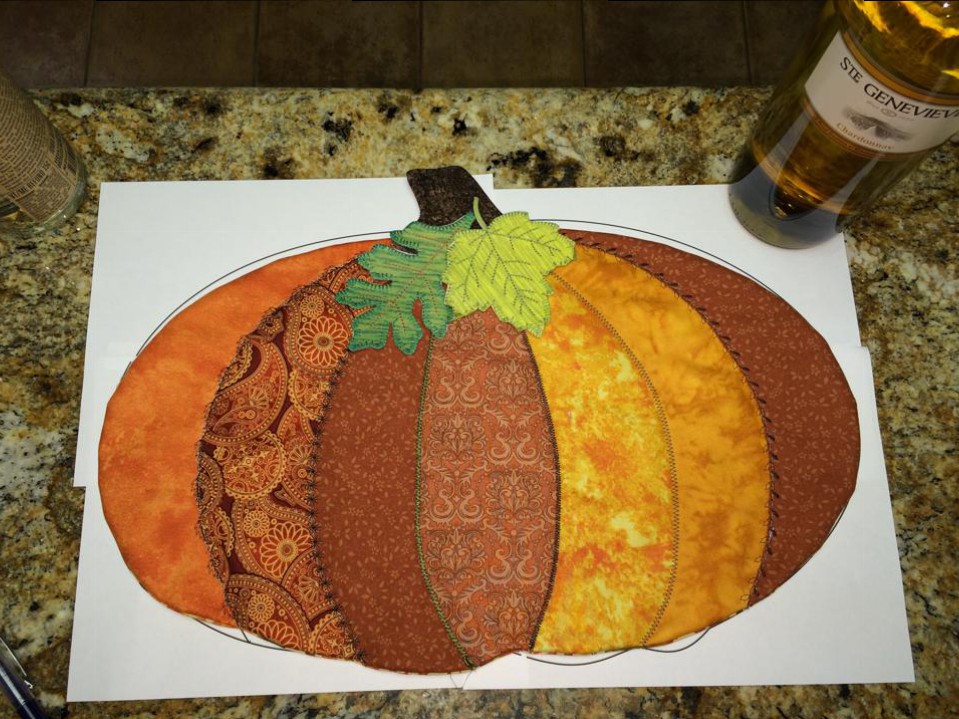
I’m not going to show how I did it yet… I want to find any interesting foibles by making another sample tomorrow. For now… Here is a pic of what I did in just under an hour and 30 minutes.

Modified Fast Piece Applique Quilted Pumpkin