Beginning Free Motion Class Supplies List November 25, 2014

cropped-cropped-20131208-181349.jpg
For those of you who are taking my class. Here is a link to the pdf which contains the list of supplies and pre-work that you will need to do in order to be ready for the class.

If you have several feet that might work (see pdf) and don’t know which one is best, bring them all. we can talk about them in class.

Download Supply List by Clicking Here

Creatives Worldwide Blog Hop

As you all know, I’m a fan of Rose Hughes and her fast piece applique method. I have all her books and I can’t recommend them enough for anyone wanting to get into art quilting. She is now participating in a blog hop with this . I decided to follow along too.

Four questions to answer and I think it might clarify some things in my mind.

#1 What am I working on?
I’m working on four projects concurrently. The first is my giant rainbow elephant applique that is currently on my long arm. The second is a first time attempt at a drunkards path. I’m a member of the San Antonio Modern Quilt Guild and so I’m using a ‘modern’ ashy grey solid and mixing it with my beloved batik. All shades of blue in this case. I have no idea how it’s going to come out. Currently the blocks are all over my dining room table while I get inspired as I move them around. Hubby calls this “working on your puzzle”. The third thing I”m working on is a “fast piece appliqued” sea-horse art quilt. My friend Carol wanted to learn how to do it and so we each picked out a scene to do. We’ve got the piecing done but not the couching and quilting. I can never be working on just one thing at a time. I love having something arty that needs embellishing around that is portable so I can work on it in the car or on a plane. The fourth thing on my quilty agenda is outlining and making samples for my free motion quilting class that I’m teaching in November. I decided having some sample of thread tension and speed related issues would be nice to show. I think it’s like doing a foot book or a stitch out of all the stitches one’s machine can do. I’m learning a lot. The process of teaching and prepping to teach is very educational to me. It’s making me grow and be a better quilter myself.

#2 How does my work differ from others in the genre?
I supposed I don’t have a style yet. I’m still learning, trying other’s methods and muxing them together to invent easier ways of doing them. So I don’t know that it differs, other than I really mix it up a lot and you’ll find lots of different techniques on my work. Right now, you probably won’t see anything done the same way twice either. I don’t really like rules. So I suppose free form and rule free is more the way I do things. Though my drunkards path quilt now has a lot of straight lines between the blocks. hmm… guess I’m breaking my personal ‘rules’ too.

#3 Why do I create what I do?
Inspiration comes from everywhere. But most of all, I get inspired when I’m told I can’t do things “that way” or “that’s not going to work” or “no one does it that way” or “that’s not art.” Hearing statements like that just fire me up and make me want to prove that it can and is and is possible.

#4 How does my creative process work?
With my career in coding and web design work, I have always had the philosophy “work hard now, so I can be lazy later.” That translates to thinking about things a lot before starting work. I would rather get it right the first time and have a plan for dealing with the problems than get blind sided by issues later and have to apply a lot of bandaids to the code. Do it right the first time, so it wouldn’t have to be redone a second time. Take the time to do it right. That said, my philosophy, while great for programming, can get in the way of art. What ends up happening is that I tend to ponder on something for way too long before I go for it. But I am not fixed once set on a path. I also tend to switch strides in the middle of a plan and morph it into something else, something better.

Pet Post Cards

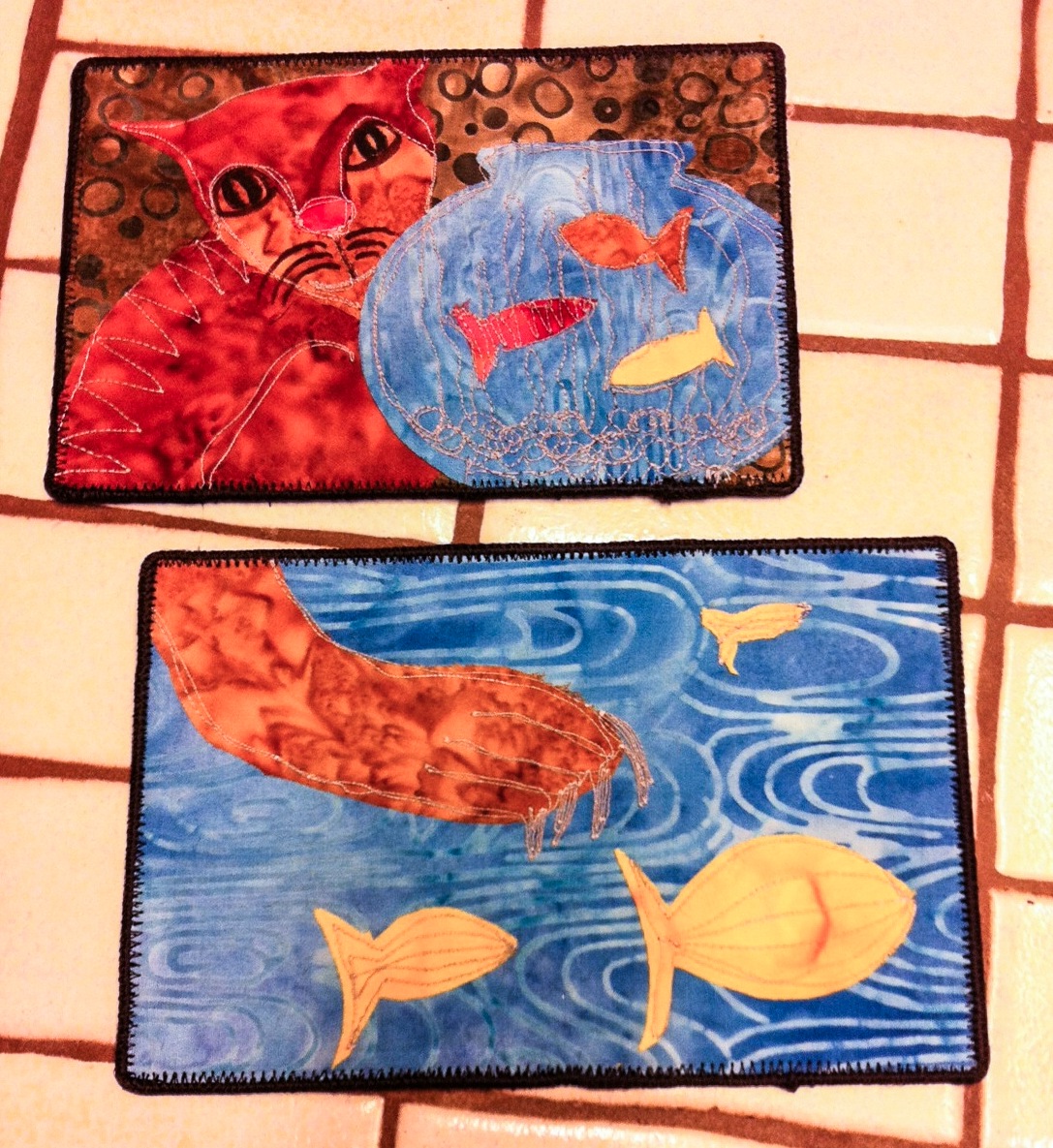
SAMQG is doing pet post cards as a charity outreach project and the cards will be available at the Houston Quilt Show 2014. I was inspired to make these by a memory of my bad cat who tormented my fish. Actually, I always thought the fish were tormenting the cat. He never managed to catch a fish. Though he did get wet.

My Bad Cat Pet Post Cards

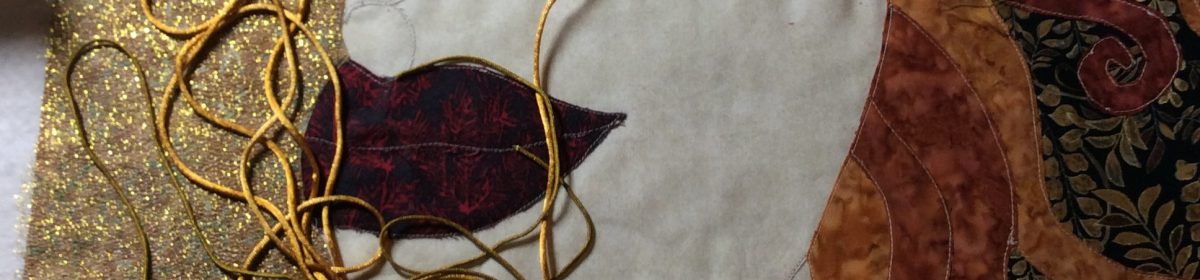
We made post cards that used all kinds of techniques. My Bad Cats are raw edge appliqué and have a rat tail cord art quilt edging method to finish them off.

The rat tail cord edging is actually pretty easy. First use a narrow long zig zag to seal off the edges of your quilt sandwich. Then widen your stitch just a teeny bit, lay a rat tail cord right next to and touching the edge and zig zag it on the quilt. THEN, widen your stitch just a bit more and change the length so it is not quite a satin stitch. Since you stitched around twice already, there is enough thread already laid down that a true satin stitch won’t be necessary for a neat and pretty finish.

I’ll show in some future post how to make the ends of your rat tail edge meet up nicely.

Sarah of SAMQG Rocks!

I joined the San Antonio Modern Quilt Guild back in March of this year. I’ve been to a few other guilds to check them out but the SAMQG seemed like a really awesome bunch of women. They are very active and do a lot of stuff. At the meetings, there is a lot of humor, good natured ribbing, acceptance of being and doing things differently, women from all walks of life and backgrounds. Diversity of just about any definition you want to define exists in this group. The tie that binds these women together is quilting. It’s a passion for all of them.

The group is really open to impromptu sew-ins. For instance, Sarah, said one day.. one of my friends family was hurt in the Oso mud slide. We sent a bunch of quilts but they were all girly things, nothing to give to the men, to the male rescue workers… And wa-la three days later Sarah and I had organized a sewing at a community center halfway between us. We put out the word and people showed up and sewed on and off all day. At one time we had 6 people sewing all at once. I volunteered to use my longarm and an all over edge to edge pattern so we could get it done quickly as the friend was getting on a plane to go to Oso in just a couple of weeks. Sarah put the binding on it.

Six months later, I’m amazed at the woman. Sarah is the charity coordinator for the SAMQG guild. She rocks. She seems to be really in touch with what is going on in the greater San Antonio area. She has us making pet postcards, baby quilts for hospitals, auction quilts for women’s causes in San Antonio, AND she also holds MD Anderson close to her heart. If you have been reading my blog a while.. then you know my ’cause’ is the rarer lesser known cancers like the rarer sarcomas (Hello! I lived through it). Well, Sarah is a big fan of their Ovarian Cancer department. She is getting our guild to make quilts that MD Anderson auctions off online every year to help raise funds for ovarian cancer research.

I have no idea how she finds out about all the stuff she tells us about. I find it admirable that she takes her role in the guild so seriously and is so passionate about it. In short, Sarah Rocks!

I’m tired of geometry in modern quilts

The more I see modern quilt guild type
quilts, the more I like many of them. I like how the actual quilting can create a sense of motion if it’s thought out. I like the quilts that make me think or that make statements even if I don’t like the actual statement they are making. The idea that fabric can evoke emotions is really cool.

However, I am getting tired of rectangles and squares. So many of them look alike. I had a thought a few days ago about how I was tired of geometric patterns and that free form flowing shapes are really interesting to me right now.

So I’m taking three simple fabrics and am going to see what I can do with them. The first two are bland ombré hand dyes in ashy blue and tan. The third fabric is burnt orange that actually is in the same shade as the tan just not diluted w grey like the tan. I’m challenging myself here. Not a single one of my beloved batiks in sight, and a lot of improv free cutting is going to happen. I plan on keeping the geometry to a kind of minimum.
20140521-180738-65258128.jpg

Cheapest quilting and sewing tool I own! Pencils!

Did you know regular old yellow number two school pencils are 1/4 inch in diameter? I always have them laying around to mark things.

What a quickie tool to grab to measure a seam allowance!

Did you know you can tape two yellow pencils together and then the center of their leads will be 1/4 inch apart?

What a quickie way to draw a line 1/4 inch away from another line!

What a quickie way to draw two lines 1/4 inch apart!

My Insights on Color Theory and Why CMYK Rules my Universe.

CMYK rules my art world. And, it should rule yours. I have known about and used both RGB (red, green, blue) and CMYK (Cyan, Magenta, Yellow, K (I’ll explain the K later) for years. But I really didn’t understand them until now. I thought CMYK just was something printers had to do because of the inks they used.. and I was kinda right, but mostly wrong. It had to so with the inks, the paper, the coatings, the …well.. the everything.

I’m taking a class is all about CMYK and why it is better than RGB for my art. RGB is what we learned in elementary school only because it is easy to show. RGB is for transmitted light. RGB is about adding colored light together to create. Starting from nothing, the absence of light, adding light of specific colors until you reach your desired outcome.

CMYK is about starting with white light and subtracting colors until you reach your desired outcome. CMYK is for light-absorbing color processes. Quilts, fabric, paints and inks are ‘colored’ by all reflected light. But it is light passed through light-absorbing pigments in the form of ink, paint, dyes, and more. A CMYK color wheel will really help you get the best results when using these mediums. C-Cyan, M-Magenta, Y-Yellow, K- key (the key or color plate is used in printing to determine the lightness or darkness of the CMY). They don’t mention the K part in the class specifically, but they do talk a lot about it. Every time they are talking about tint, shade, or tone.. they are teaching us about the K part of CMYK color theory.

We were all short-changed in K-12 when it came to color theory unless you had a really rocking art teacher who had lots of time. If you took drama classes you necessarily taught RGB. Theater uses light and lots of it. Theater uses light passed through gels (transparent colored films) to “color” the light. RGB is all about transmitted light. It’s really easy to show RGB color theory and limited budgets meant most schools taught RGB theory. A few colored gels, a source of white light and, wa-la, you had an easy quick demonstration on RGM. Lightness or darkness in RGB is controlled by the amount of light you allow to shine through. 

CMYK. Now that is the true beast we need to learn for doing art (that isn’t working directly with manipulating the light itself). In CMYK, the lightness or darkness is a result of two things. 1) the pigment itself and how a human perceives it. and 2) the amount of white or black mixed into the pigment). Number 2 is a very different animal than just dimming or turning up the electric current in a light. Human perception is obvious for those of us who can see. For example, Yellow is ‘lighter’ in perception than Purple. 

In CMYK color theory, color passes through the pigments/dye/ink on the paper (they absorb some color) then reflects off of whatever surface is under the pigments and back through the light absorbing pigments before going to your eye. So you can think of CMYK as subtractive. Color is subtracted (absorbed) or removed from the light bouncing off the background behind the pigments laying on the surface. It is also affected by the background surface. And, it is subtracted (absorbed) again when the light passes back up through the pigment back to your eye. The background plays a huge role in all this. Traditionally the background is white, white canvas, white fabric, white paper, white gesso, etc.

In CMYK you can create black by mixing all the colors together. In practice, this actually end up looking like a dark mess. That is because it is really hard in nature to find 100% pure colors, or to even create them out of things we find on earth. Everything we create is slightly tainted. So actually finding three pure CMY colors and mixing them exactly has astronomical odds against it happening. Also laying on enough pigment to absorb all the light is a requirement. This could end up looking like a thick scab. This can get really nasty if you ask me. So printers and artists for thousands of years have “cheated” by making black pigments. Actually they are just made of things that are really dense and absorb a lot of light like coal. Anyway, using black pigment with the three subtractive primary colors allows wonderful things to happen. It’s why your inkjet printer today uses at least four inks, Cyan, Magenta, Yellow and Black is used for the key). Black is used when the muddier combo color of the CMY isn’t desired. To get a really rich black, printers will often mix a layer of CMY with a layer of black over it. Newer printers often have a “Photo” black cartridge. This is actually CMY and Black inks together. No biggie.. it just works.

To get lighter ‘colors, you just use less pigment so less absorption of light occurs. This isn’t always practical either. Our eyes are super sensitive detectors. We would have to grind down the pigments to itsy bitsy teensy weensy bits and sometimes we can’t grind them down enough. We’d also have to evenly and at regular spacing spread the pigments out at just the right rate to get the color we want. All that is terribly hard. So again, artists have been “cheating” for years by using “white” pigments as a carrier substance to thin out the colors and spread them out. No biggie.. it just works.

Having the K factor is the Key… it allows us to take a pure color and thin it down to make lighter colors or thicken it up (and even add black) to make dark colors. 

You can even include the K factor as your substrate, using a grey or black back ground will allow you to achieve changes without having to even alter your pure color pigments.

All that is nice.. but how does it apply to quilts..

As well as making different color choices now, I think about the K factor (lightness/darkness/value) as much as the color itself. I realized I used to pick all the colors but they usually had the same K factor. So if I made a green and blue quilt (analogous color scheme) I had all light, or all medium colors in terms of  how light/dark they were. Because I am studying CMYK, I think about the K factor (lots of pros call it value or include it in their value definition). So now if I were to do an analogous color scheme quilt, I also make sure I have some light, some dark, some medium mixed up in the actual colors themselves.

Does it work? All I can say is that it does! Try it. If you are used to using a color wheel as a guide to help you choose fabrics for a quilt… Go pick fabrics using a CMYK color wheel, also known as an Ive’s Color Wheel, and watch your once drab color picking skills suddenly become professional. Remember the K factor part of CMYK and You’ll be quilting with the stars.. at least with your color choices. 

I know people are saying things about my art that they didn’t before.. they are saying things like wow, I love those colors, I didn’t think of putting those together but it really does work well, and more. They never commented about my choices before I made the switch. They do now. And more importantly I think so to. 
Wonder tape makes for professional looking pillowcase finishes.

I have discovered Wonder tape! Love this stuff. If you are doing a pillowcase type finish and just can’t get those pesky edges to fold in and stay aligned, wonder tape is your friend! It is two sides and tacky so you can reposition the cloth to your hearts content and when you are happy you can use an iron to fuse it down to it will stick really hard. Then you can sew it. It’s a convenient 1/4 inch wide so makes getting that seam to match with the other side of the opening you want to close really easy. After you sew it, it will seems kinda stiff with that tape in there. But it sewed easy and didn’t gum up my needle. The wonder part comes after you wash the item. The tape dissolves away and disappears leaving no trace it was ever there!

I used this in my free form table runner class yesterday and the students projects came out fabulous. Even the beginner never ever sewed before student produced a really well done project. You could not tell where the opening was that was used to turn the table runner inside out.

Spiral Eye Needles are The BEST Invention EVER!

Pam turner creating her prototype Spiral Eye Needles

Spiral Eye Needles are The BEST Invention EVER!

I found these spiral eye needles about two years ago and I have fallen deeper in love with them every time I use one. Pam Turner had an idea and invested her life savings in it because she felt it was so good. I agree with her. 

Her easy threading needles blow the Clover top loading (not-so-easy) needles completely away. Pam’s needles are ‘side’ loading.. get that? Side loading. That means the thread goes in from the side. The advantage is the thread isn’t pulled out of the end slot when going through the fabric because THERE IS NO END SLOT. This easy threader stays threaded. 

I use this most of all for burying quilt threads on my long arm. But I multiple size of her spiral eye needles and use them for embroidering, beading and other quickie things. 

The only minor problem I have found is when embroidering if I have the side slot turned towards the fabric and pull the needle through with pressure. In this situation, once in a while the fabrics weave can get caught in the slot. The advantage of not having to strain my eyes when threading far outweighs this. It’s easiliy solved by spinning the needle so the slot is not pulled against the fabric as I stitch.

As I get older, my eyes switch more slowly from distance vision to close up. Threading needles has become harder and takes longer because of it. The Spiral Eye Needle actually is faster to thread even when my eyes are focusing well. I’ve given a few of them as gifts. 

These aren’t the most inexpensive needles you will ever buy, but they are the cheapest if you count the amount of time you spend threading and if your vision is a little bit off they will save you even more time.

I had a professional longarm friend tell me that the spiral eye was too expensive for her to use. I asked her how long it took her to bury threads… 10 minutes to an hour depending on thread changes… Most pros get paid by the square inch. If you could cut the thread burying time to 25% of what you spend now… how many more quilts can you get done. This is a cheap investment for a pro. And for someone like me… it’s a godsend for my eyes, sanity, and patience. 


Plus I use one of those little strawberries with sharpening grit. My favorite two year old needle is just as good and sharp as the day I got it. 

Note: These are photos from Pam’s website http://www.spiraleyeneedles.com/

Detailed Information about the Free Form Table Runner Class Feb 22, 1014

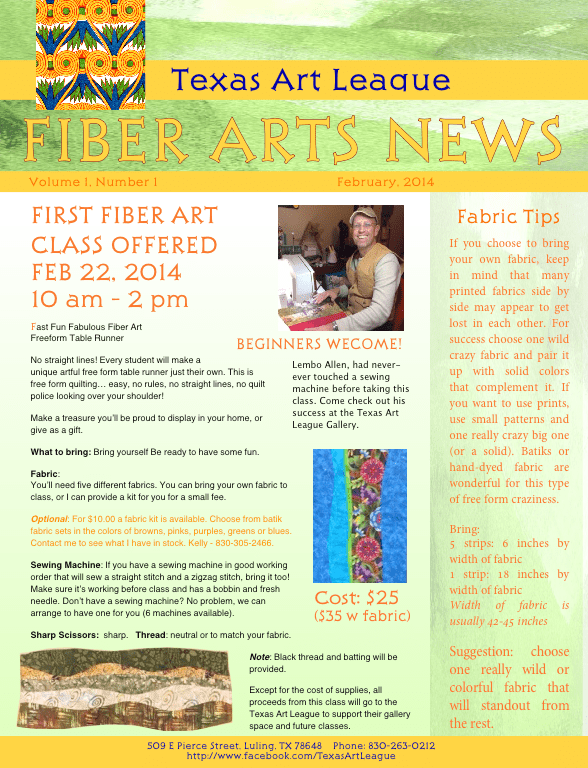
The Free Form Table Runner class being offered Feb 22, 2014 from 10 am to 2 pm. at the Texas Art League Gallery. Sign up at the Gallery. There will be a break for lunch, you can bring your lunch or some students may wish to work on their project so we arrange for lunch from the Coffee Shop, or perhaps a taco run. Iced tea and water available during the class.

Click here for PDF to
save and download.
TALfiberart-tablerunnerfreeform
For more detailed information, Please click on this image for a pdf you can save and print. This flyer will also be available in the Texas Art League Gallery; and, in the Watermelon Shop next door if the Gallery is closed.

The Gallery has limited hours but is open most afternoons Tuesday – Saturday. They would really appreciate more volunteers who would like docent at the gallery so that it may open more hours of the day.

The Texas Art League Gallery is at at 509 E Davis Street, Luling, Texas 78648.